
Expert strategies for booking holiday flights at the best possible price

Holiday airfare around Thanksgiving, Christmas and New Year’s is notoriously expensive due to high demand and limited seat availability. However, with strategic timing and an understanding of airfare trends, you can still secure reasonable fares—even on peak travel dates.
I’ve been outflanking expensive holiday flights, and I know that you can too. Today, we’re going to share the best tips for you to fly during the holidays without breaking the bank.
Understanding airline pricing trends around the holidays
As you likely already know, airlines operate on dynamic pricing models and adjust fares based on real-time demand, seat inventory and booking patterns. For most of the year, fares fluctuate in a fare “curve,” starting high, dropping during the booking window sweet spot and then rising sharply as the departure date approaches.
However, holiday travel breaks the rules. Airlines know that travelers have fixed date constraints. Most people must fly a few days before the holiday and return shortly after. This removes flexibility and allows airlines to hold fares higher, with fewer promotional drops.
That said, there are still windows when airlines release lower fare buckets, and catching these windows can make a significant difference in price.
Cheapest booking windows for each major holiday
While there’s no formal rule, here’s what I’ve found in my experience.
Thanksgiving travel (US)
- Best time to book: September through mid-October — about 50 to 60 days out.
- Avoid booking: Within 21 days of departure — prices increase sharply due to last-minute demand
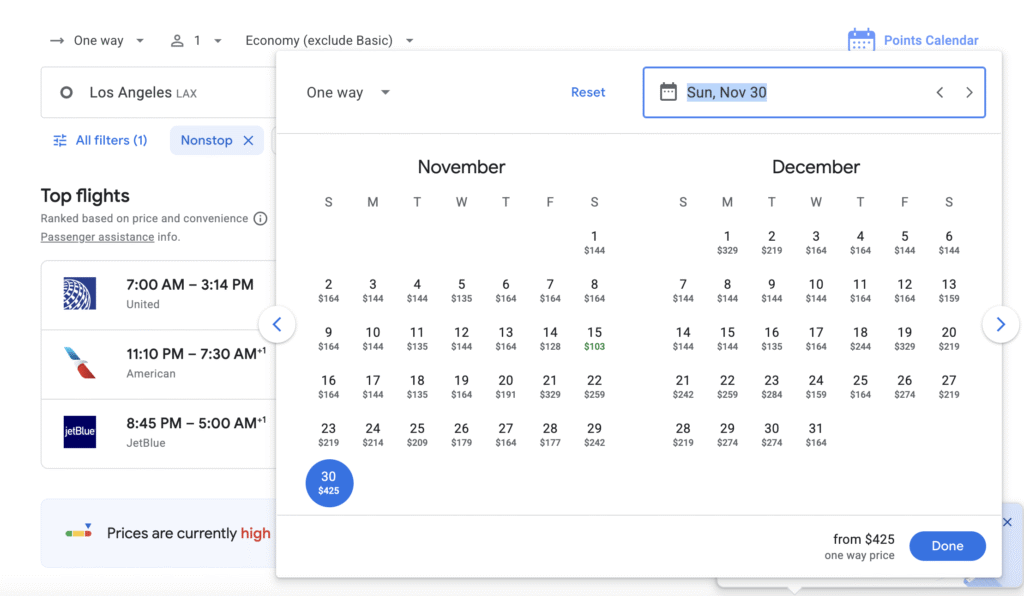
- Pro tip: Consider traveling Thanksgiving morning and returning the Tuesday after instead of Sunday, which is consistently one of the most expensive travel days of the year. For example, in this sample search for nonstop flights from Los Angeles (LAX) to New York City (NYC), the flights on the Tuesday following Thanksgiving are roughly half the price of the Sunday after Thanksgiving.
Christmas and New Year’s
- Best time to book: Early October through early November.
- Prices tend to spike after November 15, and there aren’t many chances of a price drop after that.
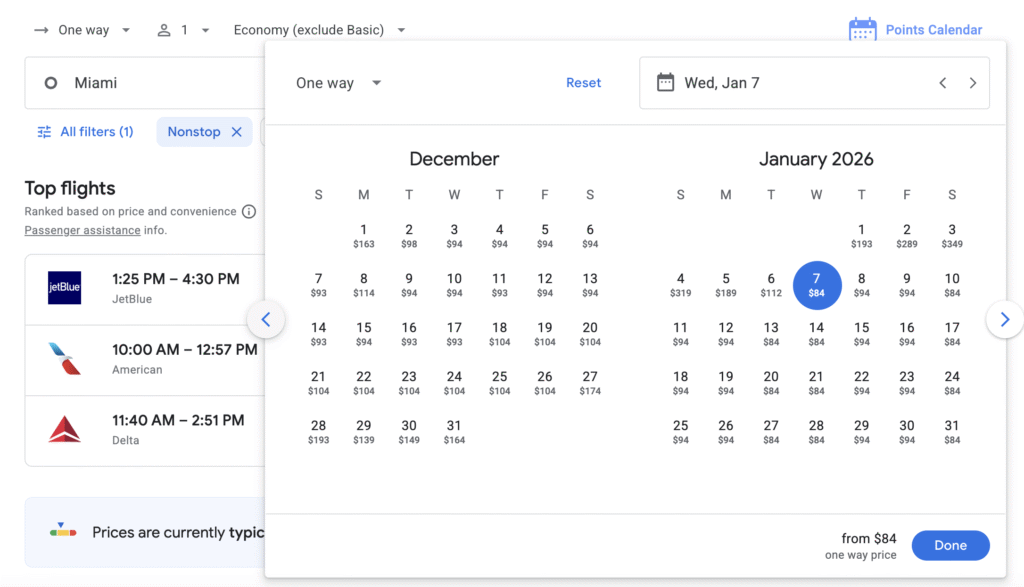
- Pro tip: If you’re flexible, flying December 24th or 25th often yields significantly lower fares than departing between the 20th and 23rd. For returns, January 3rd and January 4th are extremely high in demand — January 5th or later shows meaningful savings. That’s quite evident in this sample search from Miami International Airport (MIA) to New York City (NYC).
General rule
For international holiday flights, the sweet spot stretches earlier. You’re often best booking 90 to 120+ days out, especially for Europe and Asia holiday travel.
As for domestic holiday flights, we recommend booking 60 to 90 days in advance.

Watch for “fare dump” windows
While rare during peak holiday periods, airlines occasionally release unsold inventory at lower price brackets to stimulate bookings, especially in mid-October. These fare drops typically last 12 to 48 hours and are most common:
- Late Tuesday evenings and Wednesday mornings (the highest volume time for fare adjustments industry-wide)
- When low-cost carriers like Southwest, JetBlue or Breeze release fare sales, it can trigger competitive matching across legacy airlines.
Use price alerts and historical data to track trends
To capture these rare dips, you can set dynamic price alerts using tools like:
- Google Flights
- Capital One Travel Portal
- Kayak price alerts
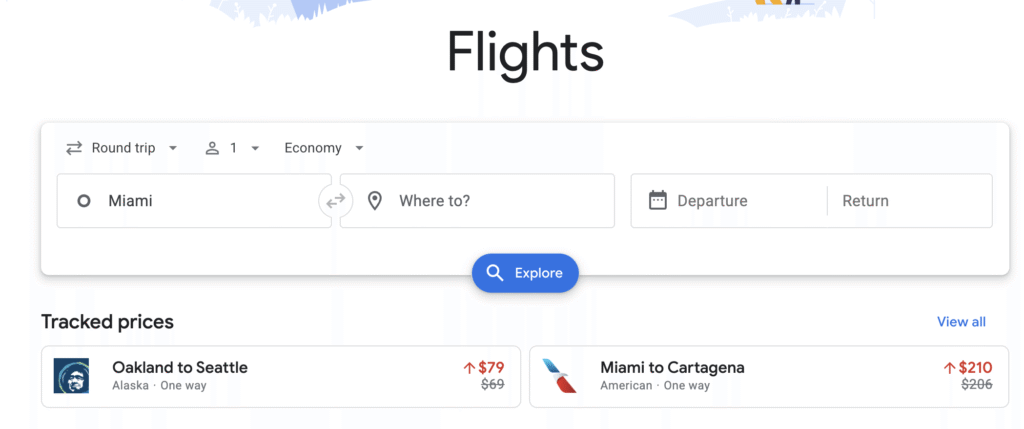
Rather than focusing on a single airline, we suggest tracking specific routes and letting aggregated pricing guide your decision. Review fare history charts to distinguish between normal fare volatility and significant price shifts, which typically signal a true purchasing window.
The best days of the week to book and fly
When to book
- Contrary to older advice, there is no magic day to book. Airfare fluctuates constantly due to automation
- That said, Monday through Wednesday show the most frequent price adjustments due to system fare sweeps.
When to fly
- Cheapest outbound days: Thanksgiving morning, Christmas Day, New Year’s Day.
- Most expensive outbound days: Two days before the holiday.
- Cheapest return days: First business day after the holiday or a week later if extending your stay.
Consider alternate airports and split ticketing
Holiday fare inflation hits major hubs like LAX, JFK, ORD and SFO especially hard. To dodge this premium, you can look at secondary airports (e.g., Long Beach instead of LAX, BWI instead of DCA/IAD, Oakland instead of SFO).
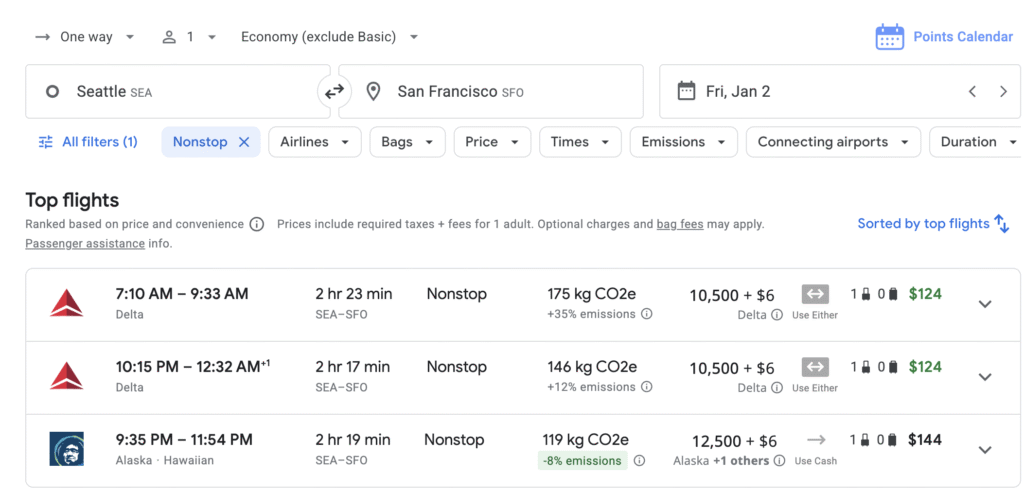
For example, on this search from January 2, the least expensive standard economy fare is $124 from Seattle (SEA) to San Francisco (SFO).
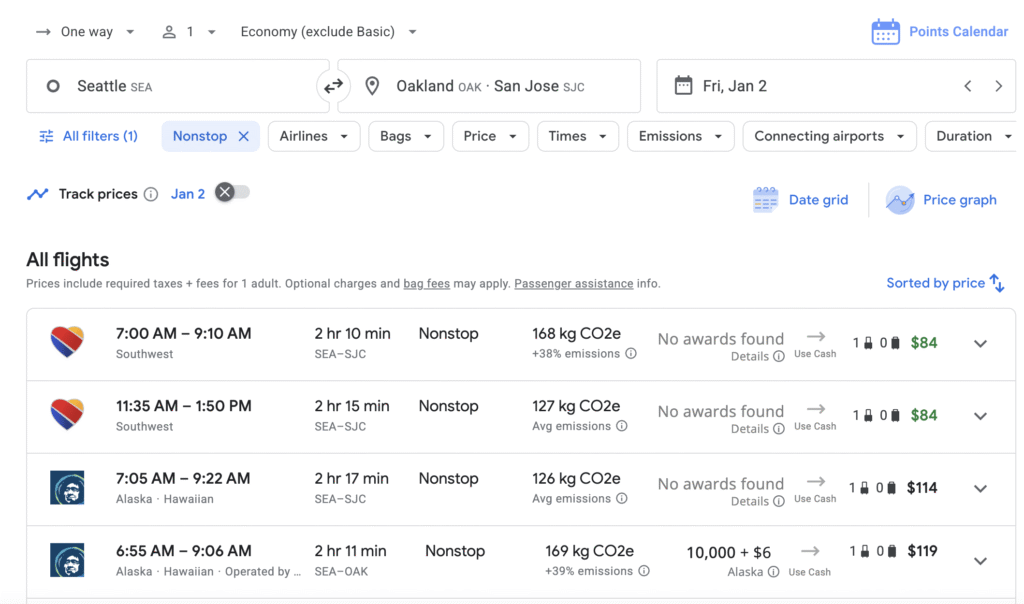
But by adding in San Jose (SJC) and Oakland (OAK), you can find flights from $84.
You can also use split ticketing or hidden-city ticketing strategies cautiously — tools like Skiplagged can expose pricing anomalies where a connecting flight is cheaper than a direct one. That’s evident in this search from San Diego (SAN) to Washington’s Dulles Airport (IAD), where a Skiplagged itinerary terminating in Orlando (MCO) saves $53.

Use your points and miles strategically
Holiday periods are prime redemption windows, especially when fares inflate. Programs like Southwest Rapid Rewards, United MileagePlus and American AAdvantage use dynamic pricing, meaning redemptions fluctuate with cash fares.
However, fixed-value programs, such as Turkish Miles & Smiles or Avianca LifeMiles, can sometimes offer outsized value on United domestic flights during the holidays.
If you’re going to book award flights, do it as early as schedules open (typically 330 to 360 days out) for the best chance at saver-level awards.
Strategy checklist for booking holiday flights cheaper
| Tip | Ideal Timeframe | Goal |
|---|---|---|
| Set flight alerts | 4–6 months before travel | Monitor trends before the booking window opens |
| Book domestic flights | 50–80 days out | Secure pre-peak pricing before the fare surge |
| Book international flights | 90–120+ days out | Lock in award or cash fares early |
| Target fare drops | Tuesday–Wednesday evenings | Watch for matching sales and low-fare buckets |
| Use miles and miles | Anytime fares surge | Protect against last-minute price jumps |
| Fly on off-peak days | Holiday morning departures | Take advantage of low-demand travel windows |
Bottom line
The holidays are the single most expensive time to fly, but you can lock in fares during the pre-peak booking window. When you book two to three months out, with careful attention to travel date flexibility, you can save hundreds per ticket. When you combine that with real-time alerts, strategic off-peak flying and the smart use of points and secondary airports, you’ll be booking like a travel analyst, not a last-minute traveler.


- Annual fee
- $95
- Our valuation
- $1,538Milesopedia first-year estimate First-year valueWelcome bonus$1,538Total$1,538Rewards on your spending are not included. The calculator that adds them from your own profile is on the card's page.
- Milesopedia first-year estimateFirst-year valueWelcome bonus$1,538Total$1,538Rewards on your spending are not included. The calculator that adds them from your own profile is on the card's page.
- Welcome offer
- 75,000 points
on Chase's website
Holiday Flight Booking: Frequently Asked Questions
When is the best time to book Thanksgiving flights?
Book Thanksgiving flights 50-60 days in advance, ideally between September and mid-October. Avoid booking within 21 days of departure when prices spike sharply. Consider flying Thanksgiving morning and returning Tuesday after (instead of Sunday) to save significantly on airfare.
How far in advance should I book Christmas and New Year’s flights?
Book Christmas and New Year’s flights in early October through early November. Prices typically spike after November 15 with few opportunities for drops. Flying December 24-25 or returning January 5+ often provides better value than peak dates.
What are the cheapest days to fly during the holidays?
Cheapest outbound days include Thanksgiving morning, Christmas Day, and New Year’s Day. For returns, fly the first business day after holidays or extend stays by a week. Avoid departing 2 days before holidays and returning on Sundays, which are typically the most expensive travel days.
Do airlines ever have sales during holiday periods?
While rare, airlines occasionally release “fare dumps” during mid-October to stimulate bookings. These typically occur late Tuesday evenings and Wednesday mornings, lasting 12-48 hours. Low-cost carrier sales can trigger competitive matching across legacy airlines.
Should I use points and miles for holiday flights?
Yes, holiday periods are excellent for point redemptions when cash fares inflate. Book award flights as early as schedules open (330-360 days out) for best availability. Fixed-value programs like Turkish Miles & Smiles can offer exceptional value when cash fares surge.
Can alternate airports save money on holiday flights?
Absolutely. Secondary airports often avoid the premium pricing at major hubs. Consider Long Beach vs LAX, BWI vs DCA/IAD, or Oakland vs SFO. Price differences can be substantial – sometimes $40+ savings per ticket by choosing nearby alternatives.
What tools should I use to track holiday flight prices?
Set up price alerts using Google Flights, Capital One Travel Portal, or Kayak. Track specific routes across multiple airlines rather than focusing on one carrier. Review fare history charts to distinguish normal volatility from significant price shifts that signal buying opportunities.
Is there still a best day of the week to book flights?
No magic booking day exists due to automated pricing systems. However, Monday through Wednesday show the most frequent price adjustments due to system fare sweeps. Focus on booking timing (60-90 days for domestic, 90-120+ for international) rather than specific weekdays.
What’s the difference between domestic and international holiday booking windows?
International holiday flights require earlier booking – typically 90-120+ days in advance, especially for Europe and Asia. Domestic flights can be booked 60-90 days out. International routes have more limited inventory and higher demand, making early booking more critical.
How much can I realistically save with these strategies?
Savings can be substantial – hundreds of dollars per ticket when combining optimal booking timing, flexible travel dates, alternate airports, and strategic use of points. The key is booking 2-3 months out with careful attention to off-peak travel days rather than waiting until the last minute.
Our editorial integrity
Our reviews and rankings are based on an objective assessment. Advertisers do not influence our content. We may receive compensation through some links; our analysis and opinions remain independent.