
Chase Sapphire Reserve StubHub Credit: How to Use Up to $300
Loading article…
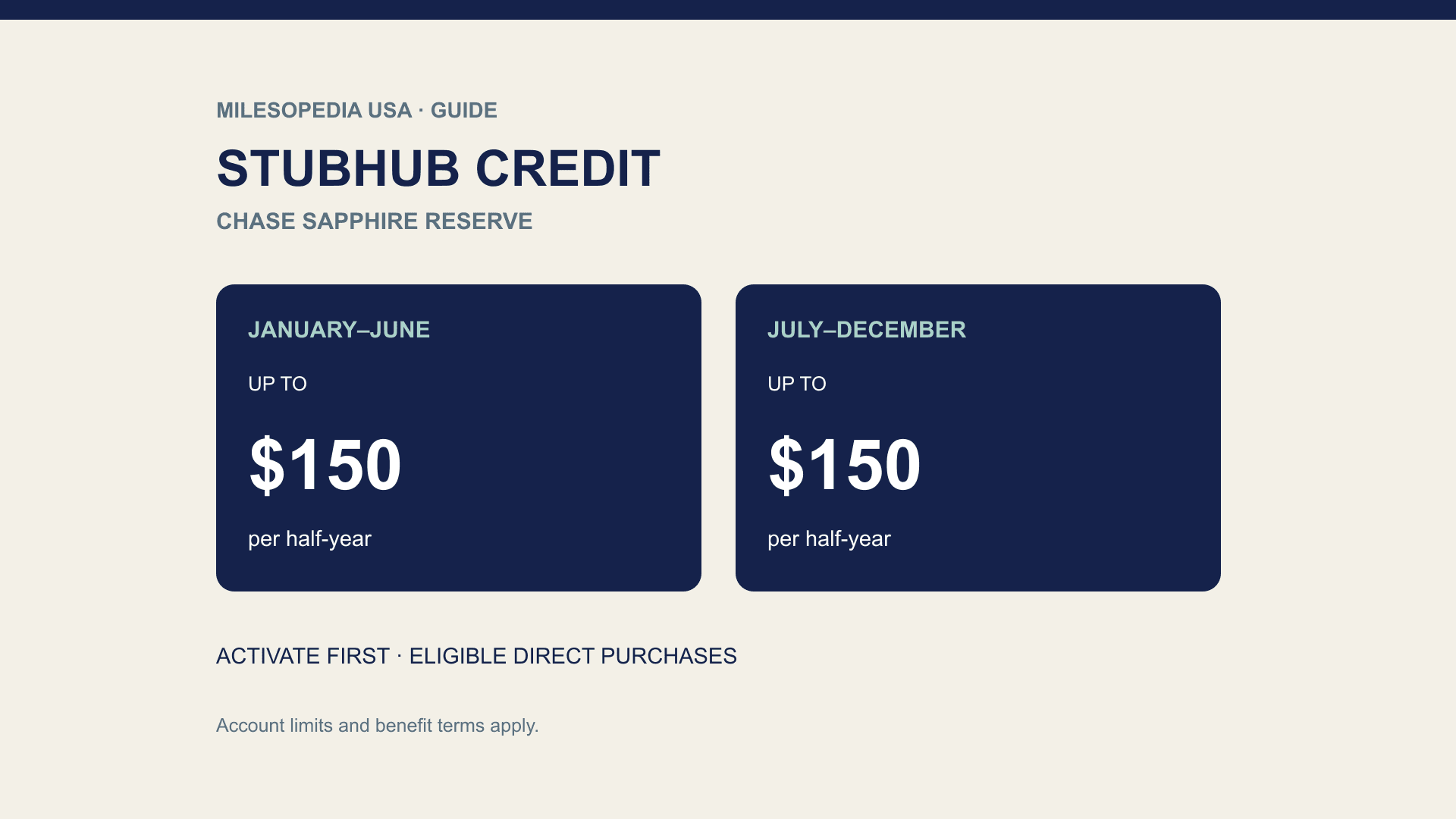
The Chase Sapphire Reserve StubHub credit provides up to $300 in statement credits per calendar year, split into up to $150 from January through June and up to $150 from July through December. Activate the benefit before making a qualifying purchase.
Eligible purchases must be made directly through the specified StubHub or viagogo websites or apps with the personal Sapphire Reserve account. Gift cards are excluded. A ticket's event date does not determine which half-year allowance applies.
This guide follows Chase's official benefit explanation and the detailed terms on the Sapphire Reserve card page, checked on October 28, 2026. All dollar amounts are U.S. dollars.
| Allowance | Calendar dates | Shared account limit |
|---|---|---|
| First half-year | January 1–June 30 | Up to $150 |
| Second half-year | July 1–December 31 | Up to $150 |
| Total annual maximum | Each calendar year through December 31, 2027 | Up to $300, subject to the two separate half-year caps |
This benefit is for the personal Chase Sapphire Reserve described in those terms. Do not assume that the similarly named Sapphire Reserve for Business or Sapphire Preferred includes the same StubHub allowance.
The official terms currently describe the benefit through December 31, 2027. That is the stated availability period, rather than a promise that the benefit will continue afterward.
Each half-year has a separate cap. The annual headline does not allow a $300 reimbursement for one purchase in a single half-year. Unused capacity from January through June does not add to the July through December allowance.
Read our Sapphire Reserve review for the card's wider features. This guide focuses on the ticket credit, its activation and the transactions that can qualify.
Sign in to Chase online or in the Chase Mobile app, choose the eligible card and open its benefit information. Find the StubHub benefit and complete the activation. Chase describes this as a one-time activation requirement.
Confirm that the account shows the benefit as active before submitting a ticket order. Keep a record of the confirmation and review how much of the current half-year credit remains.
Chase's educational article says purchases made before activation are not eligible. Holding the card, adding it to StubHub, or seeing the benefit in a marketing list is not the same as activating it.
An authorized user can make an eligible purchase on the account after activation. The spending still uses the shared account allowance. Adding an authorized user does not create another $150 for the half-year.
If you cannot find the activation or do not know when your account becomes eligible for its next allowance, contact Chase using the number on the card before purchasing.
The detailed terms name four qualifying channels: stubhub.com, the StubHub app, viagogo.com and the viagogo app. Use the eligible card for the purchase and confirm the final payment route.
A resale ticket shown in a search result can send you to another platform. The ticket's branding, event venue or origin does not replace the requirement to pay through an eligible merchant channel.
Gift cards are excluded. Buying a StubHub gift card during one half-year and spending it during another is not a qualifying way to preserve the card credit.
Pay attention to the transaction currency and total before confirming. The benefit cap is expressed in dollars, while an international ticket purchase may be priced in another currency. Use the final charged amount when tracking the remaining allowance.
Chase specifically warns about tickets for events in the United Kingdom that redirect from stubhub.com to stubhub.co.uk. That site is operated by StubHub International, which Chase says is not affiliated with the StubHub covered by this benefit. Those purchases do not qualify.
Do not reduce this rule to a broad claim that every ticket for every international event is excluded. viagogo.com is an eligible named channel, but each purchase must still meet the terms.
The practical check is the actual website or app and payment destination at checkout. If a ticket flow redirects you, stop and verify eligibility before treating the credit as part of the price comparison.
The first allowance runs from January 1 through June 30. The second runs from July 1 through December 31. Chase sets the end of each period at 11:59 p.m. Eastern Time on its final day.
As of this guide's October 28, 2026 check, a qualifying purchase falls in the second half-year only if the transaction is assigned to that period and credit remains on the account. Do not assume the full $150 remains available merely because it is October.
A hypothetical eligible $110 purchase could earn up to $110 back if at least that much credit remains. It would leave up to $40 for another eligible purchase in the same half-year.
A $230 eligible purchase with the full allowance available could receive at most $150 back, leaving $80 of that charge unreimbursed. It cannot borrow the next January allowance to cover the difference.
There is no minimum purchase requirement in the detailed terms. Several smaller eligible purchases can count toward the cap. You do not need to spend more than the remaining credit to use it.
The relevant period concerns the qualifying purchase and the merchant's transaction processing, not the concert, match or show date. Buying in December for a spring event is different from paying for that ticket in January.
Chase warns that merchant processing or submission delays can move a purchase into the next credit period. A checkout completed just before midnight on June 30 or December 31 does not guarantee the expiring allowance will apply.
Allow time for the purchase to process and retain the order confirmation. If a late transaction lands in the next half-year, it can use that later allowance rather than the one you intended.
The credit must be available when the qualifying purchase is made. Keep a simple record of the period, charges and credits rather than relying on the card's anniversary date. These are calendar half-years.
A ticket credit can reduce your out-of-pocket cost, but the marketplace price still matters. Compare the same event, seating area, number of tickets, delivery conditions and complete checkout total with other available sellers.
For example, assume a ticket costs $210 through a qualifying channel and your full $150 credit remains. After the credit, the hypothetical net cost is $60. If another acceptable ticket costs $50 elsewhere, using the credit is still $10 more expensive in this simplified comparison.
The benefit is a statement credit, not a reduction applied by the ticket seller at checkout. You pay the charged price first and must be able to cover the bill while waiting.
Do not count the full annual $300 as a saving when you only attend one event or cannot use one half-year's allowance. Record the amount that matches purchases you would otherwise make.
Read the seller's and platform's ticket conditions before paying. Whether a ticket can be transferred, resold or refunded is a ticketing question, separate from whether Chase recognizes the purchase for a credit.
Chase may reverse a statement credit when an eligible purchase is returned, cancelled or modified. It also reserves reversal if the card account is closed within 90 days of receiving the credit.
An event cancellation therefore requires checking both the merchant adjustment and any change to the card credit. Keep the original purchase record and subsequent emails until the financial adjustments are complete.
Do not assume that selling a ticket restores the original half-year credit. The benefit terms do not promise a reusable allowance for every later ticket transaction or refund scenario. Ask Chase about an unresolved account adjustment.
The card's detailed terms say credits should post within three business days, but may take up to four weeks. Chase's separate educational page describes one to two billing cycles. Check the current terms in your own account if the expected timing differs.
Track the charge and any credit as separate entries. A pending purchase or a marketplace confirmation is not proof that the statement credit has posted.
The account must remain open and not in default when the credit is fulfilled. Keep making required payments. If the expected credit has not appeared after the stated period, contact Chase with the activation record, receipt and transaction details.
The StubHub allowance is distinct from the card's travel credit, targeted spending promotions and merchant-specific Chase Offers. Activating a spending campaign does not activate the StubHub benefit.
Our guide to targeted Chase spending offers explains those separate campaigns. If more than one offer appears relevant, confirm each set of terms before assuming they combine.
Ticket-credit use also differs from earning or transferring Chase Ultimate Rewards points. A statement credit is not a points-transfer bonus, and no transfer is needed for this benefit.
Before your next order, confirm activation, the eligible channel, the full ticket price and the remaining half-year allowance. Compare U.S. credit cards using the credits you can actually use alongside the card's costs.
on Chase's website
Subscribe to the Milesopedia USA newsletter for updates to card benefits and practical rewards guides.

Our reviews and rankings are based on an objective assessment. Advertisers do not influence our content. We may receive compensation through some links; our analysis and opinions remain independent.